

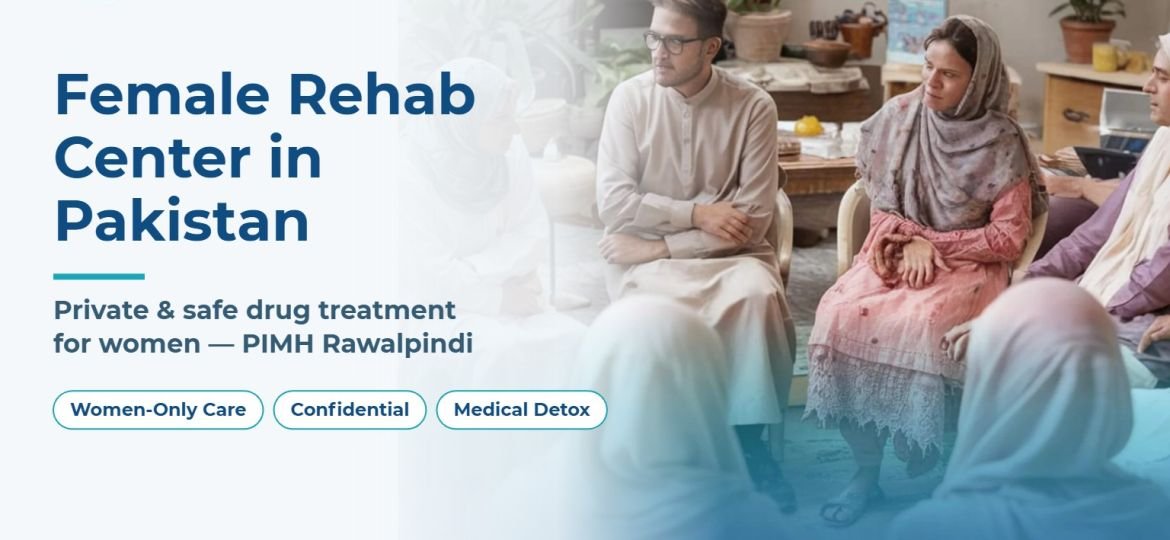
For many families, finding a female rehab center in Pakistan is one of the hardest steps in getting help for a daughter, sister, wife or mother who is struggling with drugs. Women who use substances often hide it for years because of stigma, fear of gossip and worry about their marriage or family honour. When the family finally decides to seek treatment, the first question is almost always the same: is there a safe, private place where she will be treated only with other women, by staff who respect her dignity?
This guide explains what female addiction treatment involves, why women need a separate rehab environment, the warning signs families should not ignore, and how the Pakistan Institute of Mental Health (PIMH) in Rawalpindi supports women from across Pakistan through confidential, gender-specific rehabilitation.
Why Women Need a Separate Rehab Environment
Addiction affects men and women differently. Research summarised by the U.S. National Institute on Drug Abuse notes that women can progress from first use to dependence faster and often face different health and social consequences (NIDA – Substance Use in Women). In Pakistan, cultural and social pressures add another layer:
- Stigma and secrecy: a woman’s drug use is often hidden by the family itself, which delays treatment.
- Safety and privacy: many families will not consider a facility where women share space with male patients.
- Trauma and emotional pain: substance use in women is frequently linked with anxiety, depression, relationship stress or difficult life experiences that need gentle, specialised therapy.
- Family roles: mothers and wives worry about children and household responsibilities, so treatment planning must include the family.
A dedicated ladies rehab center removes many of these barriers. Women can talk openly in therapy, rest without fear, and build trust with female-sensitive staff — which is often the turning point for real recovery.
Signs a Woman in Your Family May Need Addiction Treatment
Substance use in women is often hidden behind “stress”, “weakness” or “sleep problems”. Watch for patterns such as:
- Regular use of sleeping pills, sedatives or painkillers without a doctor’s advice, or asking different doctors for the same medicine
- Sudden mood swings, irritability, withdrawal from family and friends
- Unexplained weight loss, poor sleep, neglect of appearance or hygiene
- Missing money or jewellery, secretive phone use, new unexplained friendships
- Smell of smoke or chemicals, burnt foil, small packets or syringes in personal belongings
- Failed attempts to stop on her own, or physical discomfort when she tries to cut down
If you notice several of these signs, avoid shouting, blaming or locking her in a room. Calmly gather information and speak to a professional. Early, respectful action makes female addiction treatment far more successful.
What Happens in a Female Drug Rehab Program
Good rehab for women is not just “keeping her away from drugs”. It is a structured medical and psychological program. While every plan is individual, it usually includes the following stages.
1. Confidential Assessment
A psychiatrist and clinical team assess which substances are being used, for how long, physical health, mental health conditions such as depression or anxiety, and family circumstances. This shapes the treatment plan and helps decide whether outpatient care or residential admission is needed.
2. Medically Supervised Detox
Withdrawal from some substances can be uncomfortable and, in certain cases, medically risky. Detox should always happen under medical supervision, where symptoms are monitored and managed safely by doctors — never at home with “desi totkay” or forced isolation.
3. Individual and Group Therapy
Once the body is stable, the real work begins. Women attend individual counselling and women-only group sessions where they learn to understand their triggers, manage cravings, handle emotions and rebuild self-esteem. Evidence-based approaches such as cognitive behavioural therapy and relapse prevention skills are commonly used.
4. Treatment of Co-occurring Mental Health Conditions
Many women who use drugs are also living with depression, anxiety, trauma-related symptoms or sleep problems. Treating these alongside the addiction — rather than ignoring them — greatly reduces the chance of relapse.
5. Family Counselling and Aftercare
Recovery continues after discharge. Family sessions help parents and husbands learn how to support her without control or blame, and an aftercare plan with follow-up visits helps her stay on track. You can read more about early warning signs in our guide to drug relapse warning signs and what families should do.
How to Choose a Safe Female Rehab Center in Pakistan
Families searching for a women rehab center in Rawalpindi or a female drug rehab in Islamabad should ask clear questions before admission:
- Is there a separate, secure women’s section? Female patients should have separate living and therapy areas.
- Is a qualified psychiatrist involved? Addiction is a medical condition; treatment should be led by mental health professionals, not only “wardens”.
- Is detox medically supervised? Ask how withdrawal is monitored and managed.
- How is privacy protected? Patient information should be kept confidential.
- Is the approach respectful? Avoid any facility that uses chains, beating, humiliation or forced labour. Dignity is part of treatment.
- Is there family involvement and aftercare? A program that ends on discharge day is incomplete.
It also helps to visit the facility in person before admission. Meet the team, see the women’s section, ask about daily routine, visiting rules and how progress is shared with the family. A trustworthy center will answer these questions openly and will never pressure you into an immediate decision or make unrealistic promises of a quick “cure”.
For a broader checklist, see our article on heroin addiction treatment in Pakistan: detox, rehab and recovery steps, which explains what proper medical treatment should look like.
How PIMH Can Help
The Pakistan Institute of Mental Health (PIMH), located on Main GT Road, Chaklala Cantt, Rawalpindi, provides substance abuse treatment and gender-specific rehabilitation for women as part of its specialised mental health services. Women and families come to PIMH not only from Rawalpindi and Islamabad but from across Pakistan.
- Gender-specific rehabilitation: separate, private care for female patients.
- Psychiatry and psychotherapy: assessment and treatment of addiction along with depression, anxiety and other conditions.
- Counselling and family support: guidance for parents, husbands and children throughout recovery.
- Crisis intervention and home services: support when a family does not know how to bring a loved one for treatment.
- Holistic wellness: care that looks after body, mind and daily routine, not just the substance.
Every enquiry is handled with confidentiality. Families can first visit or call to understand the process before making any decision about admission.
Frequently Asked Questions
Is there a female-only rehab center in Rawalpindi or Islamabad?
Yes. PIMH in Rawalpindi offers gender-specific rehabilitation, which means women receive treatment in a separate, private environment. It is easily reachable from Islamabad and serves patients from all over Pakistan.
Will my family member’s treatment be kept confidential?
Confidentiality is a core part of mental health care. Patient information is shared only with the treatment team and, where appropriate, with the family members involved in her care.
How long does female addiction treatment take?
There is no fixed duration. It depends on the substance, how long it has been used, physical and mental health, and how she responds to treatment. The treating team will explain the recommended plan after assessment.
What if she refuses to go to rehab?
Refusal is common, especially at the start. Avoid force or threats. Speak to a counsellor first — families can be guided on how to talk to her, and PIMH also offers crisis intervention and home services for difficult situations.
Can women be treated for depression or anxiety along with addiction?
Yes, and they should be. Treating both together is important because untreated depression or anxiety is a common reason for relapse.
Take the First Step Today
If someone you love is struggling, you do not have to manage it alone or in secret. Contact PIMH for a confidential discussion about female rehab and addiction treatment. Call +92-51-5451112 or +92-51-5451113, emergency +92-334-2466777, email info@pimh.pk, or visit our contact page. PIMH is located Near Royal Palace Hotel, Opposite Ayub Park, Main GT Road, Chaklala Cantt, Rawalpindi (Mon–Fri, 9:30am–6:30pm).
This article is for awareness only and is not a substitute for a professional consultation.

[…] 0 By Pakistan Institute of Mental Health PIMH Blog November 18, […]